
Hot Punched Holes |
 |
 |
 |
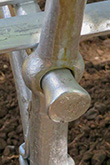
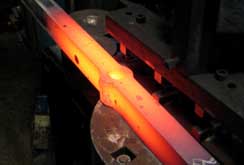
A blacksmith would traditionally make a hole by driving a punch through hot metal. The result is characterised by the aesthetically pleasing swellings around its sides. These originate from
how the metal flows away from the punch as it moves through the material. Since the metal is moved rather than being cut away, the work retains its strength. This would be lost if it were simply drilled. An additional advantage is that any shape of hole can be made with a punch, whereas a drilled hole is always round.
Verdigris' blacksmith
David Hyde uses punched holes for strength but also as design features in their own right. Scroll down for more information followed by examples that use this style of hole.
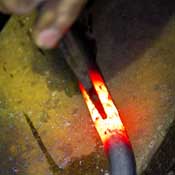
A long thin tool called a slot punch is first driven through the metal. If the work being punched is round it may roll over as the punch is struck. A lot of care is needed at this stage.
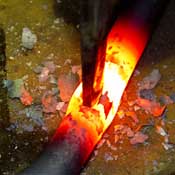
It is important that the punch doesn't wander since the hole will be made off-centre. You can see the swellings beginning to form as the metal moves away from the punch.
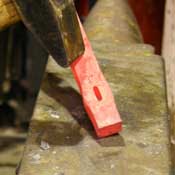
The tip of the punch becomes extremely hot, so it must be taken out of the metal frequently and cooled in water. This photo shows the slit that was formed by this initial punching.
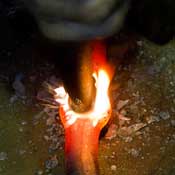
Once the slit is made, the next stage is to drive a drift through it. This spreads the metal and opens up the hole.
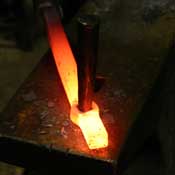
The work is supported on an anvil when punched but moved over to the pritchell hole when drifted.
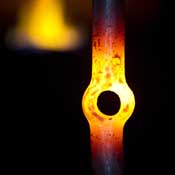
The end result speaks for itself!
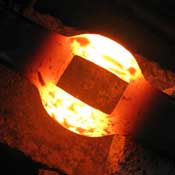
The hole made follows the shape of the drift so any shape can be made.
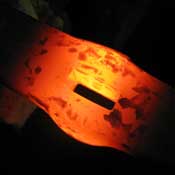
This thinner slot is used in a mortise and tenon joint.
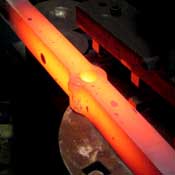
Big holes are made by striking the punch and drift with a sledge hammer. This hole is used as a structural element of a 3/4 ton gate.
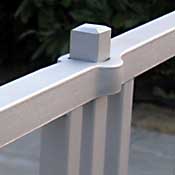
This detail is from an Art Deco gate designed around hot punched holes.
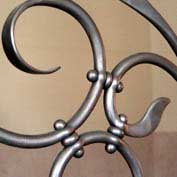
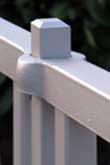
Punched holes are used with this balustrade since drilling them would leave it too weak.
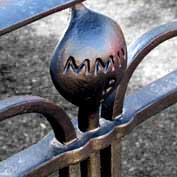
These holes emphasis the way the bars pass through the horizontal element of this gate.
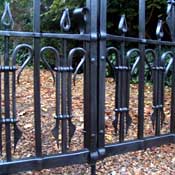
Punched holes are used throughout this gate and are a major design feature.
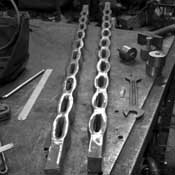
These are used as part of a large sliding gate. It was technically challenging to prevent this bar from distorting as the large slots were punched ... it required the making of specialised tooling!


